

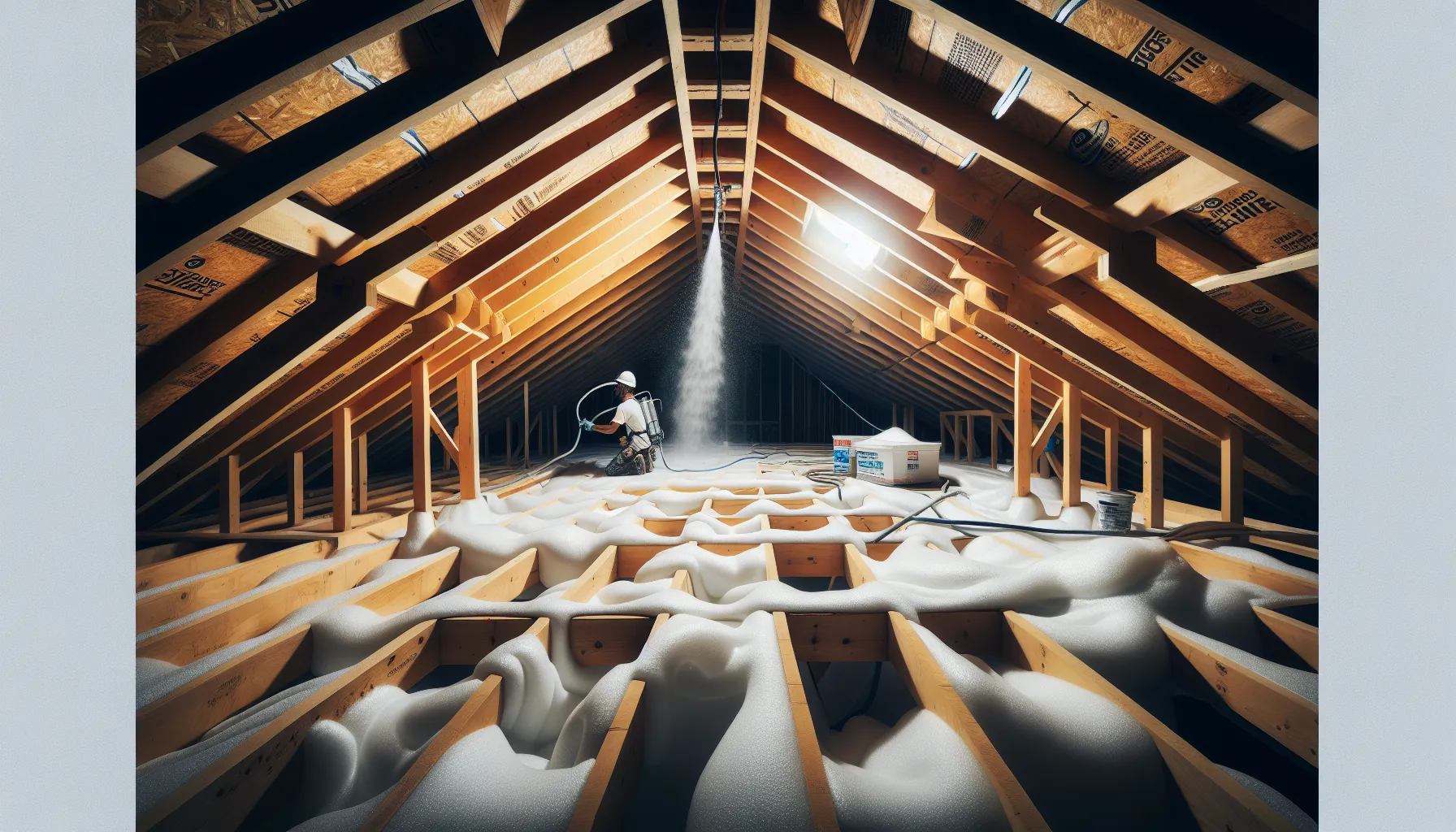
Spray foam roofing and insulation systems have gained significant traction in both commercial and residential construction. Whether applied as a complete spray polyurethane foam (SPF) roofing system on flat or low-slope roofs, or used to insulate the underside of roof decks for unvented attic assemblies, spray foam for roof applications delivers exceptional thermal performance, air sealing, and moisture control that traditional roofing insulation methods struggle to match.
Spray Foam Roofing Systems (SPF)
SPF roofing is a complete roofing system where closed-cell spray foam is applied directly to the roof surface, creating a monolithic, seamless layer that serves as both insulation and waterproofing membrane.
How SPF Roofing Works
The SPF roofing system consists of three layers:
- Substrate preparation: The existing roof surface is cleaned, primed, and any moisture issues are addressed
- Spray foam application: Closed-cell polyurethane foam is sprayed in multiple passes to achieve 1 to 2 inches of thickness (R-6 to R-14)
- Protective coating: An elastomeric coating (typically silicone, acrylic, or polyurea) is applied to protect the foam from UV degradation and provide a walkable surface
According to the U.S. Department of Energy, properly coated SPF roofs can also serve as cool roofs when white or reflective coatings are used, reducing cooling loads significantly.
Best Applications for SPF Roofing
- Flat and low-slope commercial roofs: The primary market for SPF roofing systems
- Irregular roof shapes: Foam conforms to any geometry without seams
- Roof restoration: Can be applied over existing roofing materials (single-ply, BUR, metal)
- Buildings with heavy equipment: High compressive strength supports foot traffic and mechanical units
Unvented Attic Assemblies
One of the most impactful residential applications of spray foam for roofs is creating unvented (hot roof) attic assemblies. Instead of insulating the attic floor and ventilating the attic space, spray foam is applied directly to the underside of the roof deck.
Benefits of Unvented Attics
- Brings HVAC equipment and ductwork into the conditioned envelope
- Eliminates duct losses that can account for 20-30% of cooling energy
- Creates usable attic space (storage or living area)
- Reduces ice dam formation in cold climates
- Prevents wind-driven rain and snow infiltration through vents
The Building Science Corporation has extensively studied unvented attic assemblies and confirms they perform well when spray foam is properly installed at the roof deck.
Code Requirements for Unvented Attics
The IRC Section R806.5 permits unvented attic assemblies when specific requirements are met:
- Air-impermeable insulation (spray foam) must be applied directly to the underside of the roof deck
- Minimum R-values vary by climate zone (R-20 in Zone 4 to R-49 in Zones 7-8)
- Closed-cell foam can provide the full R-value, or a hybrid approach can use closed-cell foam for air sealing with additional insulation below
- No interior vapor retarder is required when using spray foam at the roof deck
Closed Cell on Roof Deck
Applying closed-cell spray foam to the underside of the roof deck is the most common residential spray foam roof application.
Application Details
- Thickness: 3 to 6 inches depending on climate zone requirements
- R-value: R-18 to R-42 (3 to 6 inches at R-6 to R-7 per inch)
- Vapor control: 2+ inches of closed-cell foam acts as a Class II vapor retarder
- Air sealing: Creates a continuous air barrier at the roof plane
Hybrid Approach
Many builders use a hybrid approach to balance performance and cost:
- 2-3 inches of closed-cell foam at the roof deck for air sealing and vapor control
- Additional open-cell foam or fiberglass batts below to reach code R-value requirements
- This approach costs less than full-depth closed-cell while maintaining the critical air and vapor barrier
For detailed comparisons of foam types, see our guide on open-cell vs closed-cell spray foam.
Cost Per Square Foot
Spray foam roof costs vary significantly by application type:
SPF Roofing Systems (Commercial)
- New SPF roof: $4 to $8 per square foot installed
- SPF roof restoration: $2 to $5 per square foot
- Recoating only: $1.50 to $3 per square foot
Residential Roof Deck Insulation
- Closed-cell at 3 inches: $4.50 to $10.50 per square foot
- Closed-cell at 5 inches: $7.50 to $17.50 per square foot
- Hybrid (2″ CC + 6″ OC): $5 to $10 per square foot
- Average attic (1,500 sq ft): $7,500 to $15,000
For comprehensive pricing information, check our spray foam insulation cost guide.
Lifespan and Maintenance
SPF Roofing Systems
- Foam lifespan: 30-50+ years when properly maintained
- Coating lifespan: 10-15 years per coat application
- Maintenance: Annual inspections, periodic recoating
- Recoatable: Simply clean and apply new coating without removing the foam
Residential Roof Deck Insulation
- Lifespan: Matches or exceeds the life of the building
- Maintenance: Essentially maintenance-free once installed
- No degradation: Closed-cell foam does not settle, sag, or lose R-value over time
Flat Roof Applications
SPF roofing is particularly well-suited for flat and low-slope roofs because:
- Self-flashing: Foam conforms to all penetrations, eliminating traditional flashing details
- Slope correction: Foam can be applied in varying thickness to create proper drainage slopes
- No seams: Unlike single-ply membranes, SPF has no seams that can fail
- Lightweight: Adds minimal weight to the roof structure compared to built-up roofing
- Energy performance: Continuous insulation eliminates thermal bridging through fasteners
Recoating Schedules
SPF roofs require periodic recoating to maintain the protective layer over the foam:
- Initial coating: Applied immediately after foam installation
- First recoat: Typically 10-15 years after installation
- Subsequent recoats: Every 10-15 years
- Cost: Recoating costs a fraction of full roof replacement
This renewability is one of SPF roofing’s biggest advantages. While most roofing systems require full tear-off and replacement at end of life, SPF roofs can be maintained indefinitely through recoating.
Comparison with Traditional Roofing Insulation
- vs Fiberglass batts in attic: Spray foam eliminates air leakage and brings ductwork into conditioned space. Fiberglass allows air bypass and leaves ducts in unconditioned attic.
- vs Rigid foam above deck: Both provide continuous insulation. Spray foam is seamless and self-adhering. Rigid foam requires mechanical fastening and seam taping.
- vs Blown-in cellulose: Cellulose can settle over time and does not provide air sealing. Spray foam maintains its position and air barrier properties permanently.
For insights on how spray foam roofing integrates with overall building performance, explore our article on how spray foam insulation enhances energy efficiency.
To understand how roof insulation relates to underlayment choices, see our guide on choosing the right roofing underlayment.
