

Wrapped lumber gets wet when water enters the package, moisture was present before wrapping, or water condenses inside it. The same wet appearance can come from different causes. Choosing a heavier wrapper before identifying the moisture pathway can leave the underlying problem unresolved.
What to check first
- Document the wood’s condition before packing.
- Inspect seams, ends, punctures, and pooling after exposure.
- Consider temperature changes and trapped humidity.
- Match packaging, closure details, and storage to the actual shipment.
By Andrew Sutherland, founder of R-Value Associates, with over 20 years in building materials sales and distribution. Updated October 6, 2026.
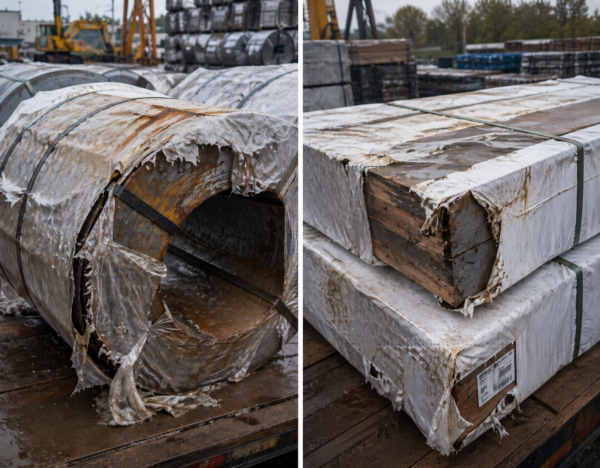
Separate rain entry from moisture already inside
A wrapper can appear intact while water enters at an end fold or an opening around a protrusion. Conversely, an enclosure can keep rain out while holding moisture that was already on or in the load.
Wood exchanges moisture with its surroundings. The USDA Forest Products Laboratory’s Wood Handbook explains wood–water relations and moisture control during drying, transit, and storage. Wrapping is one part of that process, rather than a drying treatment.
Start the investigation with three hypotheses: external liquid-water entry, moisture present at packing, and condensation during storage or transport. More than one can occur in the same bundle. Avoid assigning a cause from appearance alone.
Use the wet pattern to choose your next check
This troubleshooting table helps prioritize an inspection. A pattern is a clue, not a confirmed diagnosis: leaks, condensation, and moisture present at packing can occur together.
| Observation | Possible cause | Check next | Practical response |
|---|---|---|---|
| Wet boards near an exposed end after rain | End-fold or cap entry | Photograph the closed end; inspect gaps and compare protected and exposed ends | Correct the end detail and repair damage with compatible materials; review the affected wood separately |
| Wet patch beneath a band or corner | Puncture, abrasion, or a tear | Inspect both sides of the wrapper at the contact point | Review corner protection and band contact; repair or replace the damaged cover |
| Water in a sagging top pocket | Pooling with possible seam entry | Record sheet slope, depressions, and openings while the pack is closed | Revise support and coverage so water is shed rather than collected |
| Droplets across the inner wrap after a cold night | Condensation or trapped moisture | Compare packing condition, dew point, surface temperature, and weather history; still inspect for leaks | Review initial moisture, enclosure design, and temperature exposure before choosing a different wrapper |
| Wet boards inside apparently intact packaging | Wood or packing components were wet before enclosure; hidden entry also possible | Compare packing photos and moisture records with receiving observations | Address the initial condition and drying plan; do not simply add another impermeable layer |
| Lower bundles wet while upper bundles are dry | Runoff, splash, ground contact, or local cover failure | Inspect stack drainage, supports, overhead runoff, and lower-package openings | Correct the yard exposure and support arrangement, then reassess packaging |
Two example investigations
Scenario A: one wet end after rain. Suppose packing records show dry surfaces, and receiving photos show an open end fold beside localized wet boards. Start with that closure failure. Preserve the photos, check other openings, and trial a corrected end detail. A heavier sheet alone would leave the open end unresolved.
Scenario B: droplets inside an intact cover after a temperature change. Suppose the load was covered throughout transport, but damp stickers were enclosed and internal droplets appeared after overnight cooling. Investigate the enclosed moisture and temperatures alongside hidden leaks. Replacing the wrapper with a less vapor-permeable material could make drying more difficult. These are hypothetical examples, not R-Value customer cases.
Question 1: What was the lumber’s condition when it was wrapped?
Ask whether the product was green, air-dried, or kiln-dried, and whether it was exposed to rain after drying. Record the product, packing date, storage location, and any moisture readings taken under an agreed procedure.
A reading from one accessible board is a sample, not proof that the whole bundle is uniform. Use a moisture meter suited to the product, with the required species and temperature corrections. Agree with the lumber supplier on sampling locations and acceptance criteria rather than adopting one moisture limit for every use.
Also inspect surface water on boards, damp stickers or bearers inside the enclosure, and wet packaging materials. Ask how the pack is prepared when these conditions are found. Sealing a visibly wet load should not substitute for a documented drying or handling decision.
Question 2: Where can liquid water enter or collect?
Inspect the full package, not only the broad top face. Look for damage at bands and corners, forklift contact, exposed board ends, failed seams, and loose folds. Note whether water collects in depressions or is directed toward an opening.
- Does the closure remain secure during handling and wind exposure?
- Are protrusions protected with an approved detail?
- Can the stack’s shape create pockets that hold rainwater?
- Is water splashing or draining onto lower bundles?
- Do repair materials and tapes match the wrapper?
Photograph the package before opening and mark where wet areas occur. Keep damaged wrap and closure details available for the supplier to inspect. A leak location may explain a local wet patch, but it does not rule out a separate humidity problem elsewhere.
Question 3: Could temperature changes cause condensation?
Condensation can form when moist air meets a surface below its dew point. A package moving between warm and cold conditions may encounter that situation even without rainfall.
Record where the load was packed, its route, overnight storage, and the timing of any temperature change. Water droplets on the wrapper’s inner surface are a useful observation, but they do not by themselves prove that condensation is the only source.
Discuss the complete enclosure with the packaging supplier: air space, closure, vapor transmission, wood condition, and expected exposure. A material described as breathable does not guarantee that a densely packed bundle will dry at a useful rate.
A simple dew-point example
The National Weather Service explains dew point as the temperature at which air reaches saturation when cooled. Consider hypothetical enclosed air at 20°C (68°F) with a dew point of 12°C (54°F). If the inside wrapper surface falls to 8°C (46°F), it is below that dew point, so condensation can form at the surface without rain entering.
The dew point is an assumed measured value in this example; it is not determined from air temperature alone. Real packages exchange heat and moisture with the wood and surroundings. A temperature/humidity logger records air conditions, while a suitable surface measurement helps assess the cold surface. A reading taken after opening the pack cannot reconstruct the entire enclosed journey.
Question 4: Which water and vapor properties are documented?
Water resistance and water-vapor transmission describe different behavior. Ask for technical data for the exact material and the proposed use. A house-wrap designation alone does not establish how a finished lumber package will perform.
- What test supports liquid-water resistance, and under what conditions?
- What water-vapor transmission data are available?
- What are the approved seam, end-fold, and repair details?
- What exposure duration and UV limits apply?
- How should the wrapper behave under bands and at sharp corners?
Request the test method, result, and limitations together. Comparing isolated numbers from different test conditions can produce a misleading material comparison.
Question 5: Does the storage plan support the packaging?
Review off-ground support, drainage around the stack, overhead water sources, inspection access, and expected yard time. Decide who checks and repairs damage after unloading and who acts if the receiver finds a wet bundle.
Allowing material to remain outside longer than planned changes the exposure. Set a review date for delayed inventory rather than assuming the original shipping specification covers indefinite storage. Follow the lumber manufacturer’s instructions, especially for engineered wood products.
Question 6: Can the supplier validate a representative trial?
Before changing the entire packing operation, document the current process and trial the proposed packaging on representative loads. Compare initial condition, closure integrity, handling damage, and receiving condition under a defined inspection plan.
This is a practical process check, not a guarantee of performance in every season. A dry-weather shipment cannot validate a packaging system for extended wet-yard storage. Ask which additional testing or technical review is needed for your route and product.
A receiving checklist for a wet lumber bundle
Use the same records at packing and receipt so the investigation compares conditions rather than recollections.
- Identify the load: record bundle ID, product, supplier, packing and receiving dates, route, and storage locations.
- Photograph before opening: capture every face, seams, end closures, bands, damage, and the bundle’s position in the stack. Note rainfall, standing water, and overhead runoff.
- Map observations: distinguish water on the outside, droplets on the inside, surface wetness on boards, and moisture-meter readings. These describe different conditions.
- Use a repeatable sampling plan: record meter model, species/temperature settings, board locations, measurement depth where relevant, and individual readings. Separate accessible outer-board samples from internal samples taken during an agreed unpacking inspection. Do not treat a single reading as a bundle average.
- Protect and assess: move the load into suitable protected storage through normal handling procedures, preserve packaging evidence, and obtain the lumber supplier’s drying, acceptance, or replacement decision.
- Close the process gap: assign an owner for the closure repair, yard drainage, packing-condition check, or revised specification. Reinspect representative loads after the change.
For manufacturer-specific storage guidance, Weyerhaeuser’s lumber storage and handling resource sheet emphasizes drainage, protection from direct moisture, regular cover inspections, and avoiding ground contact. Apply the current instructions for the actual product; one manufacturer’s moisture acceptance criterion is not a universal rule for all lumber and engineered wood.
Ask for a complete data sheet, not a single “breathable” claim
For water-vapor transmission, request the exact test method, test conditions, units, and material construction. Values reported in different units or under different conditions cannot be ranked by their numerical size alone. Also distinguish a tested material sheet from the assembled bundle: seams, end caps, damage, and contact with wood change the finished system.
Compare purchasing proposals on the same load description: initial wood condition, indoor/outdoor exposure, storage duration, handling, and required receiving condition. If a supplier cannot document a relevant exposure limit, leave that field unresolved instead of treating “weather-resistant” as permission for indefinite outdoor storage.
Choose wrap from a complete exposure brief
For protective lumber wrap from R-Value Associates, supply bundle dimensions, lumber condition, packing method, storage duration, route, and the failures you are trying to address. Request confirmation that the chosen material and closure suit those conditions.
Fit belongs in this review too: a wrapper that is too small can force weak seams or incomplete end coverage. Use our lumber-bundle measurement guide to prepare a sizing sketch.
If a load is already wet, document it and contact the lumber supplier for a disposition before shipping or using affected material. For packaging selection, send R-Value your exposure brief and package photos so the discussion addresses the cause as well as the wrapper.
Frequently Asked Questions
Does kiln-dried lumber stay dry once it is wrapped?
No. Kiln drying describes an earlier condition. Later exposure, damaged packaging, and humid storage can change moisture conditions, so inspect and document the lumber at packing and receipt.
Should I puncture the wrap to let wet lumber dry?
Do not make unplanned holes. They may admit rain or weaken the enclosure. Have the lumber and packaging suppliers specify a drying and ventilation method suited to the product and storage conditions.
Can stains tell me exactly how water entered?
No. Stain patterns may guide an investigation, but they cannot reliably distinguish rain entry, condensation, or moisture present before wrapping without supporting records and inspection.
Can I reuse wrap after opening a bundle?
Only if the material and closure can still meet the specified protection requirements. Check tears, punctures, contamination, and seam condition, and use the supplier’s approved repair or replacement method.
