

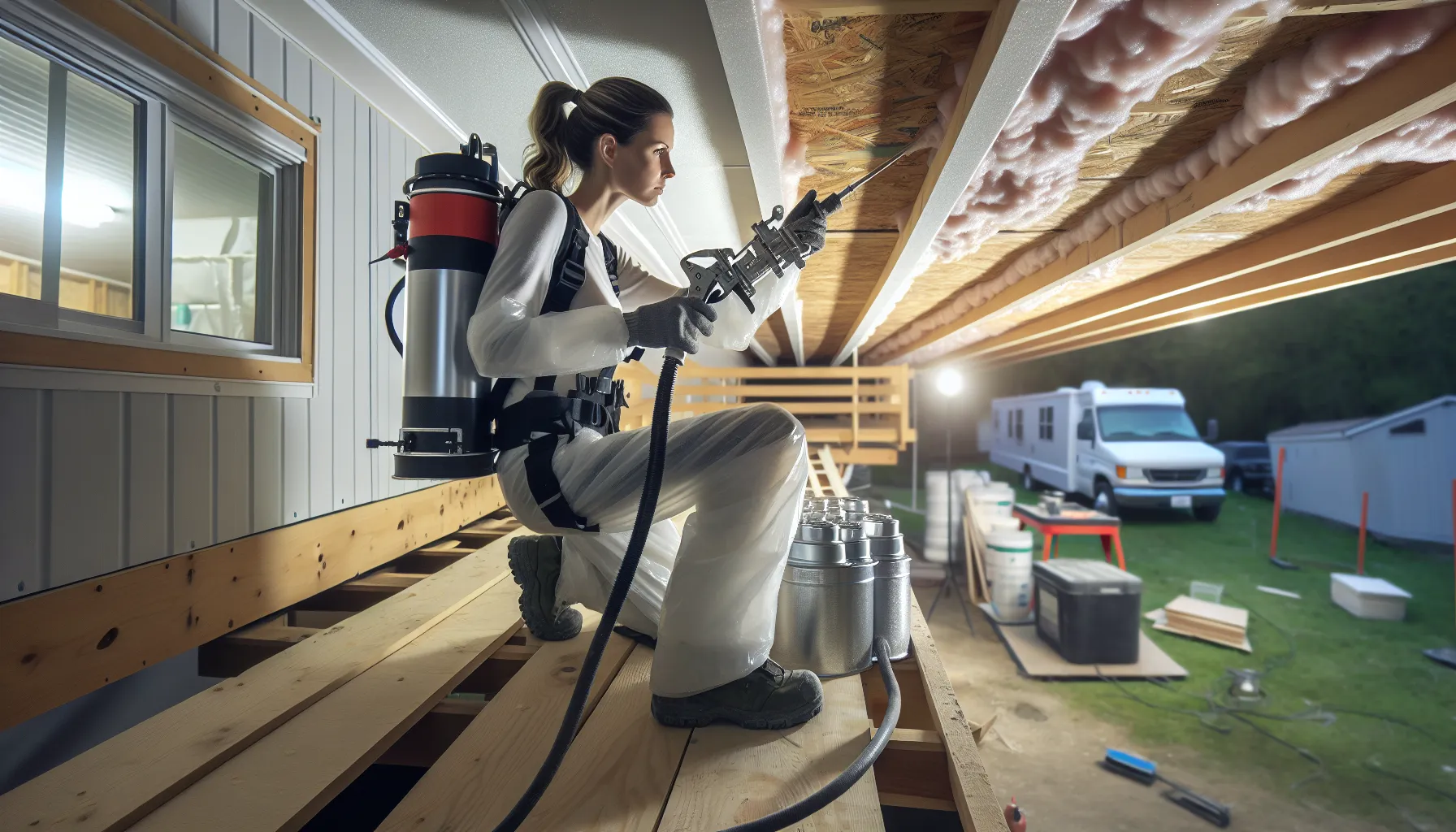
Mobile and manufactured homes present unique insulation challenges that traditional stick-built houses don’t face. The construction methods, HUD code requirements, and structural differences require specialized approaches when considering spray foam insulation for mobile homes. Understanding these differences is crucial for achieving optimal energy efficiency and comfort.
Why Mobile Homes Need Special Insulation Consideration
Mobile homes are built differently than site-built homes. They’re constructed on a steel chassis with a floor system that sits above the ground, creating an underbelly cavity that’s particularly vulnerable to heat loss. The wall cavities are typically thinner (2×3 or 2×4 framing instead of 2×6), and the roof assembly is often lower profile. These structural differences mean that every square inch of insulation performance matters.
The Department of Energy recognizes that manufactured homes can lose significant energy through the floor system, which accounts for up to 30% of total heat loss. This makes the underbelly one of the most critical areas to address with proper insulation.
Understanding HUD Code R-Value Requirements
Manufactured homes must comply with HUD code rather than local building codes. The HUD Manufactured Home Construction and Safety Standards (24 CFR 3280) specify minimum R-values based on climate zones. For most moderate climates, the requirements are:
- Ceiling: R-19 to R-30 depending on zone
- Walls: R-11 to R-13
- Floor: R-22 to R-33
Spray foam insulation can easily meet or exceed these requirements. Closed-cell spray foam provides approximately R-6 per inch, while open-cell delivers around R-3.7 per inch. This means you can achieve code-required R-values in the limited cavity depths available in mobile homes.
Open Cell vs Closed Cell for Mobile Homes
The choice between open-cell and closed-cell spray foam significantly impacts performance in manufactured housing applications.
Closed-Cell Spray Foam Advantages
Closed-cell spray foam is typically the superior choice for mobile home applications, particularly in the underbelly. Here’s why:
- Higher R-value per inch: Critical when working with limited cavity depths (2-3 inches in floors, 3-4 inches in walls)
- Moisture barrier: Creates a vapor barrier at just 2 inches thickness, protecting the floor system from ground moisture
- Structural reinforcement: Adds rigidity to the floor system and can help prevent sagging belly board
- Rodent resistance: The dense structure is less appealing to pests than fiberglass batts
Open-Cell Applications
Open-cell spray foam can work well in mobile home walls and ceilings where:
- Moisture intrusion from below isn’t a concern
- You have adequate cavity depth (3.5 inches or more)
- Budget is a primary consideration (open-cell costs 30-50% less than closed-cell)
- Sound dampening between rooms is desired
Many contractors use a hybrid approach, applying closed-cell foam in the underbelly and open-cell in walls and ceilings to optimize performance and cost.
Belly Board and Underbelly Insulation
The underbelly is the most challenging and important area to insulate in a mobile home. The existing belly board (the plastic or fabric sheet that covers the floor insulation) often sags, tears, or deteriorates over time, allowing insulation to fall out and exposing the floor to the elements.
Belly Board Replacement vs Spray Foam
Traditional belly board replacement involves removing the old material, reinstalling fiberglass batts, and securing new plastic sheeting. This approach has several drawbacks:
- Fiberglass batts can still shift, settle, or absorb moisture
- Rodents can nest in the cavity
- The new belly board will eventually deteriorate
- Air gaps reduce insulation effectiveness
Spray foam insulation for mobile homes eliminates these issues. The foam is applied directly to the underside of the floor decking, creating a continuous insulation layer that:
- Permanently adheres to the floor system
- Eliminates air infiltration
- Provides structural support to prevent future sagging
- Resists moisture and pest intrusion
Application Technique for Underbelly
Professional installers typically remove the damaged belly board entirely and spray 2-3 inches of closed-cell foam directly onto the floor joists and subfloor. Some contractors install a new belly board over the cured foam for additional protection and finished appearance, though the foam itself provides excellent weather resistance.
Wall and Ceiling Applications
Insulating mobile home walls requires careful consideration of the limited cavity depth. Most mobile homes have 2×3 or 2×4 wall framing, providing only 2.5 to 3.5 inches of cavity space.
Wall Insulation Strategy
For walls, you have two approaches:
Full-cavity closed-cell: Fill the entire 3.5-inch cavity with closed-cell foam to achieve R-21 to R-24. This exceeds HUD requirements and provides excellent air sealing, but costs more.
Flash-and-batt method: Apply 1-2 inches of closed-cell foam against the exterior sheathing for air sealing and vapor control, then fill the remaining cavity with fiberglass. This achieves R-17 to R-19 at lower cost than full foam.
Ceiling/Roof Insulation
Mobile home ceilings typically have more depth available (5-7 inches). Options include:
- Open-cell spray foam filling the cavity (R-19 to R-26)
- Closed-cell foam if higher R-value is needed in limited space
- Flash-and-batt approach similar to walls
The Building Science Corporation emphasizes that continuous air barrier performance is often more important than R-value alone, making spray foam’s air sealing capability particularly valuable.
Skirting and Ventilation Considerations
When you insulate the underbelly with spray foam, the relationship with mobile home skirting changes. Traditional advice calls for ventilated skirting to allow air circulation under the home. However, when closed-cell spray foam is applied to the floor system, you’ve created a conditioned, sealed assembly that no longer requires ventilation.
In fact, ventilated skirting can be counterproductive with spray foam insulation because:
- It allows cold air to contact the insulated floor assembly
- Wind washing can reduce the effective R-value
- Pipes and ducts in the crawl space remain exposed to freezing temperatures
Many homeowners choose to install unventilated or insulated skirting after spray foam application, effectively creating a semi-conditioned crawl space. This approach protects plumbing and HVAC components while maximizing energy efficiency.
Cost Expectations for Mobile Home Spray Foam
Understanding the cost of spray foam insulation helps with project planning. Mobile home spray foam projects typically range from $2,500 to $8,000 depending on size and scope.
Cost Breakdown by Area
- Underbelly only (most common): $2,500-$4,500 for a typical 14×70 single-wide, $4,000-$7,000 for a 28×60 double-wide
- Walls: $3,000-$5,000 additional for full wall cavity foam
- Ceiling: $2,000-$4,000 additional
- Complete home: $7,000-$15,000 for comprehensive spray foam throughout
Costs vary by region, foam type (closed-cell is more expensive), accessibility, and contractor rates. Most mobile homeowners prioritize the underbelly as it provides the greatest return on investment.
Energy Savings Potential
The energy savings from spray foam insulation in mobile homes can be substantial. Mobile homes with poor underbelly insulation often have heating and cooling costs 50-100% higher than comparable site-built homes.
Documented case studies show:
- 20-40% reduction in heating costs after underbelly spray foam application
- 30-50% reduction when combining underbelly, wall, and ceiling insulation
- Improved comfort with fewer cold floors and drafts
- Better HVAC performance and longer equipment life
The payback period for underbelly foam typically ranges from 3-7 years depending on climate and energy costs, making it one of the most cost-effective upgrades for manufactured homes. This aligns with the principles discussed in our guide on the long-term ROI of energy-efficient building products.
DIY vs Professional Installation
While DIY spray foam kits are available, mobile home applications present unique challenges:
- Working in cramped underbelly spaces requires specialized equipment
- Proper foam mixing and application is critical for performance
- Overspray can damage skirting, landscaping, or adjacent structures
- Temperature and humidity conditions must be controlled for proper curing
Most homeowners find that professional installation provides better results and value, particularly for underbelly applications where access is difficult and getting full coverage is essential.
Common Mistakes to Avoid
Several pitfalls can reduce the effectiveness of spray foam in mobile homes:
- Insufficient thickness: Not applying enough foam to meet R-value requirements
- Ignoring air sealing at crossover ducts: Where HVAC ducts cross from one side to the other
- Failing to protect plumbing: Not ensuring water lines are on the warm side of the foam
- Ventilating a sealed assembly: Installing vented skirting after creating an unventilated floor system
- Neglecting moisture sources: Not addressing ground moisture or grading issues before installation
Related Resources
For more information on spray foam insulation and energy efficiency:
