

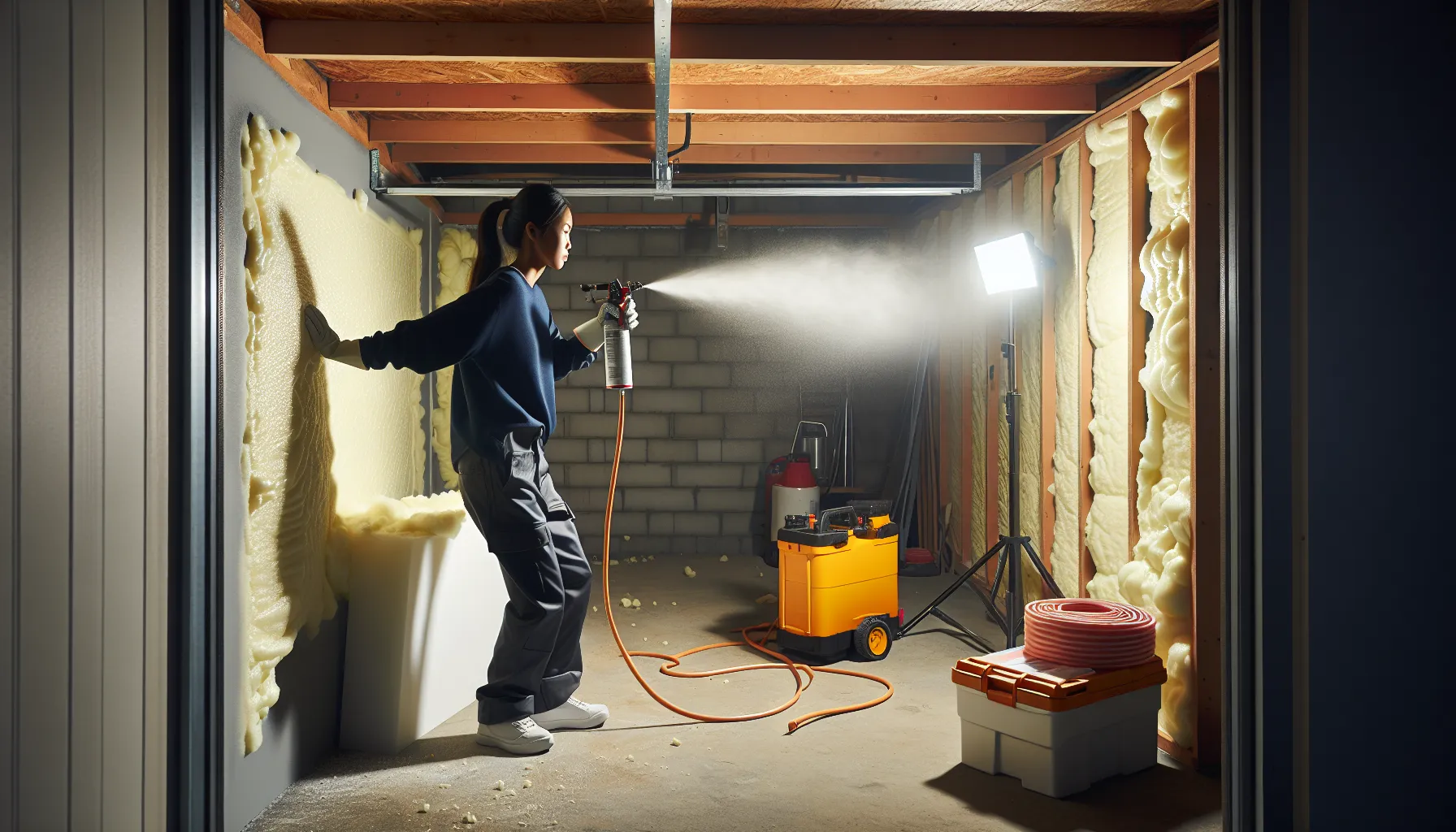
Garages present unique insulation challenges that require careful planning and material selection. Whether you’re converting a garage into living space, maintaining a workshop, or simply protecting your vehicles from temperature extremes, spray foam insulation offers superior performance compared to traditional fiberglass batts or blown-in cellulose.
Why Spray Foam Is Ideal for Garages
Unlike finished living spaces, garages typically have irregular framing, exposed utilities, and air leakage points that make traditional insulation methods less effective. Spray foam expands to fill every gap and cavity, creating an airtight seal that prevents conditioned air loss and blocks moisture infiltration.
The air-sealing properties of spray foam are particularly valuable in garages where overhead doors, service entries, and wall penetrations create significant air leakage. According to the U.S. Department of Energy, air leakage can account for 25-40% of energy used for heating and cooling in typical homes, and garages often have even higher leakage rates.
Open Cell vs Closed Cell: Which Is Right for Your Garage?
The choice between open cell and closed cell spray foam depends on your garage’s specific conditions, climate zone, and intended use.
Open Cell Spray Foam for Garages
Open cell foam (typically 0.5 lb/ft³ density) provides excellent sound dampening and costs less per square foot. It delivers an R-value of approximately R-3.5 to R-3.7 per inch. For attached garages in moderate climates where sound control is a priority, open cell can be an economical choice.
However, open cell foam is vapor permeable and should not be used below grade or in applications where moisture intrusion is likely. It also requires more thickness to achieve target R-values compared to closed cell alternatives.
Closed Cell Spray Foam for Garages
Closed cell foam (2 lb/ft³ density) is the preferred option for most garage applications. With an R-value of R-6 to R-7 per inch, it provides superior thermal resistance in a thinner profile – critical when working with standard 2×4 or 2×6 wall framing.
Closed cell foam also acts as a vapor barrier at 2 inches thickness, which is essential in detached garages or climates with high humidity. The structural rigidity of closed cell foam can add racking strength to garage walls, particularly in older structures with minimal shear bracing.
For a detailed comparison of both foam types, see our guide on open cell vs closed cell spray foam.
Cost Considerations: Budgeting for Garage Spray Foam
Spray foam insulation costs vary significantly based on foam type, garage size, and application complexity. Typical pricing ranges include:
- Open cell foam: $0.45 to $0.80 per board foot (professional installation)
- Closed cell foam: $1.00 to $1.50 per board foot (professional installation)
- DIY kits: $0.50 to $1.00 per board foot (material only, varies by kit size)
For a standard 20×20 ft two-car garage with 8-ft walls and an unfinished ceiling, expect these approximate costs for full encapsulation:
- Open cell (5.5 inches in walls, 9 inches in ceiling): $2,800 to $4,200
- Closed cell (3.5 inches in walls, 5 inches in ceiling): $4,500 to $6,800
Costs increase for detached garages with cathedral ceilings, complex roof lines, or when insulating garage doors. For detailed cost breakdowns and regional pricing variations, review our spray foam insulation cost guide.
DIY vs Professional Application
DIY spray foam kits have improved significantly in recent years, but garage applications present specific challenges that favor professional installation in most cases.
When DIY Makes Sense
Small spray foam kits (200-600 board feet) work well for:
- Rim joist sealing in attached garages
- Air sealing around garage door frames and service entries
- Small workshops or single-car garages (under 400 sq ft)
- Touch-up work on existing insulation
Successful DIY application requires proper safety equipment (respirator, protective suit, gloves), adequate ventilation, and careful temperature management. Most kits require substrate temperatures between 60-90°F and perform poorly in cold weather.
For guidance on DIY approaches, consult our spray foam insulation kit DIY guide.
When to Hire Professionals
Professional installation is recommended for:
- Full garage encapsulation (walls and ceiling)
- Detached garages with complex roof geometry
- Projects requiring building permits or energy code compliance
- Cold weather applications (professionals have heated equipment)
- Garages with existing moisture issues or structural concerns
Professional installers bring calibrated equipment that maintains proper chemical ratios, heated hoses for consistent application, and experience identifying potential issues before they become costly problems.
Attached vs Detached Garage Considerations
Attached Garage Insulation Strategy
Attached garages share at least one wall with conditioned living space. The shared wall should be treated as an exterior boundary with full insulation and air sealing. Focus areas include:
- Shared walls: Insulate to exterior wall standards (R-13 to R-21 depending on climate zone)
- Garage ceiling: If there’s living space above, insulate to attic floor standards (R-30 to R-60)
- Exterior walls: Optional but recommended for temperature moderation and sound control
- Garage door: Consider insulated doors or retrofit kits to minimize thermal bridging
For attached garages in cold climates, spray foam on the shared wall prevents ice damming on the main house roof and reduces heating system strain.
Detached Garage Insulation Strategy
Detached garages require full perimeter insulation if you plan to heat or cool the space. Key considerations:
- Vapor barrier placement: Closed cell foam at 2+ inches eliminates need for separate vapor barrier
- Foundation insulation: Extend spray foam to below-grade foundation walls if workshop use is planned
- Roof assembly: In cold climates, unvented roof assemblies with spray foam prevent ice dams and roof damage
- HVAC planning: Properly insulated detached garages maintain temperature with minimal heating/cooling equipment
Vapor Barriers and Moisture Management
Moisture management is critical in garage insulation design. Garages experience high humidity from vehicle snow/rain melt, humidity infiltration through overhead doors, and temperature cycling.
Closed cell spray foam at 2 inches or greater provides a Class II vapor retarder (0.5 to 1.0 perms), which is appropriate for most climate zones. According to Building Science Corporation, the vapor barrier should be located on the warm side of the insulation in heating climates.
In mixed-humid climates or where open cell foam is used, consult local building codes regarding vapor barrier requirements. Some jurisdictions require 6-mil polyethylene vapor barriers over open cell foam in garage applications.
Climate Zone Requirements
International Energy Conservation Code (IECC) climate zones dictate minimum R-values for garage insulation:
- Zone 1-2 (Hot climates): R-13 walls minimum; closed cell provides thermal mass benefits
- Zone 3-4 (Mixed climates): R-13 to R-20 walls; R-30+ ceilings if conditioned
- Zone 5-6 (Cold climates): R-20 to R-21 walls; R-38 to R-49 ceilings; closed cell recommended
- Zone 7-8 (Very cold/Arctic): R-21+ walls; R-49+ ceilings; closed cell essential for moisture control
Closed cell spray foam at 3.5 inches in 2×4 walls delivers R-21 to R-24.5, meeting or exceeding requirements for all climate zones. This eliminates the need to fur out walls or use 2×6 framing.
Installation Best Practices
Successful spray foam installation in garages requires attention to these critical factors:
- Surface preparation: Remove dust, oil, and debris; spray foam requires clean substrates for proper adhesion
- Electrical and mechanical: Complete all rough-in work before foam application; post-foam modifications are difficult
- Ventilation during cure: Maintain ventilation for 24-48 hours post-application; off-gassing requires air exchange
- Multiple pass application: Apply in 2-3 inch lifts to prevent overheating and ensure complete cure
- Trim and finish: Excess foam should be trimmed flush before drywall installation
For broader context on how garage insulation fits into whole-building performance, see our article on building envelope design.
Common Mistakes to Avoid
Avoid these frequent pitfalls in garage spray foam projects:
- Insufficient thickness: Don’t sacrifice R-value to save money; under-insulated garages perform poorly
- Ignoring air sealing: Seal penetrations, wire chases, and sill plates before foam application
- Wrong foam type: Using open cell in high-moisture environments leads to mold and deterioration
- Inadequate curing time: Rushing finish work before complete cure causes adhesion failures
- Neglecting fire barriers: Some jurisdictions require ignition barriers (drywall) over exposed foam
Return on Investment
Spray foam insulation in garages delivers measurable returns through reduced energy costs, improved comfort, and increased property value. Attached garages with proper insulation reduce heating and cooling loads on adjacent living spaces by 15-25%, while detached garages become usable workshop space year-round.
Energy savings vary by climate, but homeowners in cold climates typically recover spray foam costs within 5-8 years through reduced heating bills. The moisture control and structural benefits provide additional long-term value that traditional insulation cannot match.
