

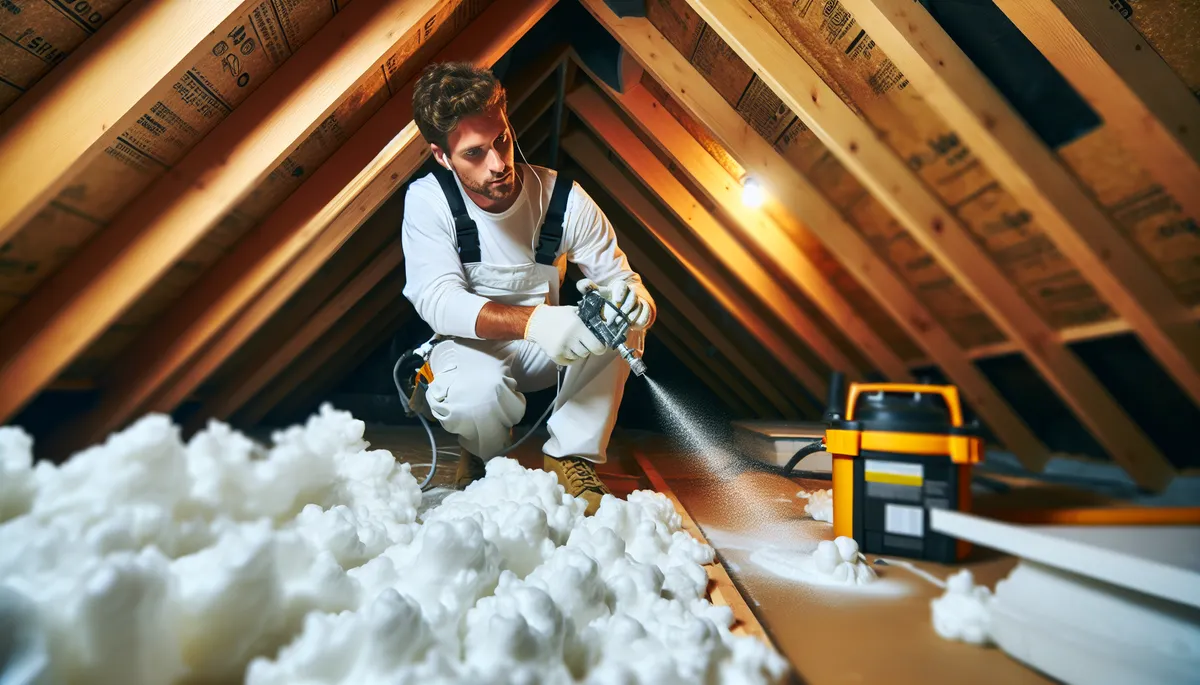
Spray foam insulation cost depends on the surface being sprayed, the foam type, and its installed thickness. A price per square foot is useful only when the quote states the depth. For example, an illustrative installed rate of $1.50 per board foot becomes $3.00 per sprayed square foot at 2 inches, or $7.50 at 5 inches. A home’s floor area alone cannot tell you the insulation bill.
Cost planning at a glance
- Board feet = sprayed surface area in square feet × thickness in inches.
- Installed cost = board feet × the contractor’s installed rate, plus separately quoted work.
- Bulk material cost per board foot = delivered A/B set price ÷ usable yield. Material-only pricing does not include installation.
- Measure attic floors, sloped roof decks, walls, and rim joists separately. A 2,000-square-foot house can have much more than 2,000 square feet of surface to insulate.
By Andrew Sutherland, founder of R-Value Associates. Updated October 3, 2026. Prices below are in U.S. dollars; examples explain estimating methods and are not project quotes.
Spray Foam Insulation Cost Per Square Foot
For a published contractor benchmark, South Central Services’ spray foam estimating sheet lists $0.25–$0.75 per board foot for open-cell foam and $1.15–$1.75 for closed-cell. These are regional contractor figures, not a national average or an R-Value Associates installation offer. Confirm current local pricing and what the quote includes.
Converting that benchmark illustrates why thickness matters:
- Open-cell at 3.5 inches: 3.5 × $0.25–$0.75 = about $0.88–$2.63 per sprayed square foot.
- Closed-cell at 2 inches: 2 × $1.15–$1.75 = $2.30–$3.50 per sprayed square foot.
Deeper attic insulation costs more per square foot because it uses more foam. Mobilization, removal, difficult access, coatings, and repairs may also change the total. Compare quotes at the same specified thickness and scope.
Floor Area, Sprayed Surface Area, and Board Feet
These three measurements answer different questions:
- House floor area: the home’s horizontal floor space. A two-story 2,000-square-foot house may have a roughly 1,000-square-foot footprint.
- Sprayed surface area: the actual faces receiving insulation, such as net wall cavities, an attic floor, or the underside of a sloped roof. Measure each surface and account for openings.
- Board feet (BF): foam volume. One board foot covers one square foot at one inch thick. It is not one square foot at any depth.
Example: 1,000 square feet of sprayed surface at 3 inches requires 3,000 board feet before allowances for application losses. A product yielding 600 board feet would cover only 200 square feet at that depth under the stated yield conditions.
How Thickness Changes Spray Foam Cost
The table uses assumed installed rates of $0.50/BF for open-cell and $1.50/BF for closed-cell to show the calculation. Replace these inputs with your contractor’s quote. The depths are estimating examples, not code recommendations or equivalent R-values.
| Foam type | Depth | BF per sq ft | Assumed $/BF | Cost per sq ft |
|---|---|---|---|---|
| Open-cell | 3.5 in | 3.5 | $0.50 | $1.75 |
| Open-cell | 5.5 in | 5.5 | $0.50 | $2.75 |
| Open-cell | 10 in | 10 | $0.50 | $5.00 |
| Closed-cell | 2 in | 2 | $1.50 | $3.00 |
| Closed-cell | 3 in | 3 | $1.50 | $4.50 |
| Closed-cell | 5 in | 5 | $1.50 | $7.50 |
At a fixed board-foot rate, doubling depth doubles the foam-volume charge. The complete job price may change differently because setup and other work do not necessarily scale with volume. Ask the installer to specify the product’s tested R-value at the proposed thickness. Foam selection also depends on the assembly, available depth, and moisture-control requirements.
Spray Foam Attic Cost: Floor or Roof Deck?
Establish where the insulation boundary will be before calculating the price. A vented attic insulated at its floor and an unvented attic insulated along the roof line have different surface areas and requirements. PNNL’s unvented attic guidance explains roof-line insulation, moisture control, and the need to meet local code requirements.
- Attic floor: measure the ceiling-plane surface to be insulated; include relevant access and penetration details.
- Roof deck: measure the sloped underside of the roof and any gable or knee-wall surfaces in the scope. Do not substitute the home’s floor area.
- Quote separately: old-insulation removal, roof or moisture repairs, access work, required protective barriers, and HVAC or ventilation changes.
Worked attic example: 1,000 square feet of actual roof-deck surface at an assumed 5-inch closed-cell depth is 5,000 BF. At an illustrative installed rate of $1.50/BF, the foam-volume portion is $7,500. An assumed 10-inch open-cell depth at $0.50/BF is 10,000 BF, or $5,000. These are separate pricing scenarios; the appropriate assembly and thickness must be designed for the home.
How Much Does It Cost to Spray Foam a 2,000 Sq Ft House?
A defensible estimate starts with a measured scope, not a single whole-house price. Consider this illustrative one-story 40-by-50-foot house:
- Floor area: 40 × 50 = 2,000 sq ft.
- Exterior wall perimeter: 2 × (40 + 50) = 180 ft.
- At a 9-foot wall height: 180 × 9 = 1,620 sq ft of gross wall area.
- Assume 220 sq ft of windows and doors: 1,400 sq ft of net wall surface for this simplified example.
- Assume a separately measured sloped roof-deck area of 2,500 sq ft. Gable walls and other surfaces are excluded here.
The table holds the illustrative closed-cell installed rate at $1.50/BF. It changes only the sprayed scope and depth:
| Scope | Area × depth | Board feet | Example cost |
|---|---|---|---|
| Walls only | 1,400 sq ft × 2 in | 2,800 BF | $4,200 |
| Attic floor only | 2,000 sq ft × 5 in | 10,000 BF | $15,000 |
| Roof deck only | 2,500 sq ft × 5 in | 12,500 BF | $18,750 |
| Walls + roof deck | 2,800 + 12,500 BF | 15,300 BF | $22,950 |
Attic-floor and roof-deck rows are alternative scopes, not instructions to insulate both. Actual cavity measurements, roof geometry, specified R-values, local rates, minimum charges, and separately quoted work will change the result. None of these totals is an R-Value Associates offer or a national average.
55-Gallon Drum Set Yield and Material Cost
A bulk A/B set normally includes one drum of isocyanate and one drum of resin. Open-cell and closed-cell formulations have different expansion and yields; a portable kit’s rating cannot be used for a drum set.
For a product-specific reference, ArmorThane’s published ArmorFoam guide reports about 5,000 BF per closed-cell set and 17,000 BF per open-cell set at perfect yield. Those are that manufacturer’s examples, not guaranteed field yields or a statement of which products R-Value supplies. Actual usable output depends on the formulation and application conditions.
Calculate from a current written quote: delivered set price ÷ expected usable board feet = material cost per BF. Include freight and applicable tax in the price basis and confirm whether the supplier’s yield is theoretical or field-based.
Illustrative bulk calculation: assume a $2,000 delivered set price and 4,000 usable BF. $2,000 ÷ 4,000 = $0.50/BF in chemicals. At 3 inches, that equals $1.50 per sprayed sq ft in material. If usable yield falls to 3,200 BF at the same price, the material rate becomes $0.625/BF, or about $1.88 per sq ft at 3 inches. These inputs are assumptions, not verified current R-Value pricing.
For current product availability, set pricing, and the matching yield documentation, explore our 55-gallon spray foam drums. Bulk chemicals require suitable professional equipment; their cost excludes labor, rig operation, preparation, protective barriers, and contractor overhead.
DIY Kit Cost vs. Professional Installation
Compare a kit’s actual listed yield with the required board feet, not the number in its product name. As checked October 3, 2026, Tiger Foam’s TF600FR listing shows a single-kit price of $729 and a theoretical yield of 529 BF. That calculates to about $1.38/BF, or $2.76 per sprayed sq ft at 2 inches, for foam material before freight, tax, protective equipment, and losses. Verify the listing before buying.
A kit purchase is a whole-unit expense. For example, 300 sq ft at 2 inches needs 600 BF before losses, so one 529-BF kit is insufficient. Use the price tier for the actual order quantity and allow for realistic usable yield.
Small, suitable jobs may be candidates for kits; larger or complex assemblies warrant an experienced applicator. Follow the product’s approved application limits, safety data, protective-equipment requirements, and ventilation and reoccupancy instructions. EPA’s ventilation guidance directs users to the manufacturer for product-specific ventilation and reoccupancy requirements.
What Else Changes the Installed Price?
- Foam and assembly specifications: product, thickness, required thermal performance, and moisture-control design.
- Preparation and access: masking, removal, disposal, tight spaces, lifts, and substrate repairs.
- Application conditions: surface preparation, temperature, equipment settings, and losses can affect usable yield.
- Code and finish requirements: required ignition or thermal barriers and any permitted product-specific exceptions.
- Job size and location: mobilization, minimum charges, crew time, freight, and local labor rates.
Energy savings are project-specific. Do not assume a fixed savings percentage or payback period. An energy assessment can help compare options; simple payback is the relevant incremental installed cost divided by estimated annual savings.
Get a Quote You Can Compare
Ask each installer to itemize the same surfaces, foam product, installed thickness, target R-value, and board footage. Confirm whether its rate includes labor and equipment and list removal, coatings, repairs, taxes, and minimum charges separately. Check insurance, qualifications, warranty terms, and the ventilation and reoccupancy plan.
Contractors sourcing bulk material can request a spray foam material quote from R-Value Associates. Send the product or foam type, required board feet, delivery ZIP code, and schedule so the price and yield can be checked on the same basis.
Frequently Asked Questions
How do I compare a square-foot quote with a board-foot quote?
Divide the square-foot price by the specified thickness in inches to get the comparable board-foot rate. For example, $4.50 per sprayed square foot at 3 inches equals $1.50 per board foot. Compare the same foam product, thickness, and included work.
Can I estimate a 2,000 sq ft house from its floor area?
Floor area alone is insufficient. Measure the walls, attic floor or sloped roof deck, and any other surfaces in the scope. Multiply each surface area by its specified depth, then apply the quoted rate. A two-story house also has a different footprint from a one-story house with the same floor area.
Does a 55-gallon drum set cover 600 square feet?
There is no universal coverage figure. A complete A/B set has a product-specific board-foot yield. Divide usable board feet by the installed thickness in inches to find square-foot coverage. Confirm the exact product and whether its stated yield is theoretical or field-based.
How many spray foam kits or drum sets should I order?
Divide the required board feet by the expected usable yield per kit or complete set, then round up to whole units. Account for application losses once in the calculation. The purchase cost can exceed the cost of foam consumed because unused material remains.
What should an attic spray foam quote include?
The quote should identify whether foam goes on the attic floor or roof deck, measured surface area, foam product, installed thickness and R-value, and total board feet. Ask for separate amounts for removal, repairs, required protective barriers, access work, and any ventilation or HVAC changes.
Is bulk spray foam material pricing the installed price?
No. A drum-set price covers chemicals on the stated delivery and tax basis. Installation also involves labor, equipment, preparation, application losses, required barriers, and overhead. Request an itemized installed quote to compare the complete project cost.
