

To measure lumber bundles for protective wrap, record the finished package’s maximum length, width, and height, then calculate the material needed for the wrapping pattern you will actually use. Board count or nominal lumber size alone will not tell you which roll to order. Overlap, end folds, stickers, and projecting boards can change the fit.
Quick sizing checklist
- Measure the largest outside dimensions of the assembled bundle.
- For a complete rectangular cross-section wrap, start with 2 × (width + height), then add the supplier-approved seam allowance.
- Record end coverage separately. Confirm which dimension runs across the roll.
- Calculate roll yield from the cut length, then validate it with a trial bundle.
By Andrew Sutherland, founder of R-Value Associates, with over 20 years in building materials sales and distribution. Updated October 6, 2026.
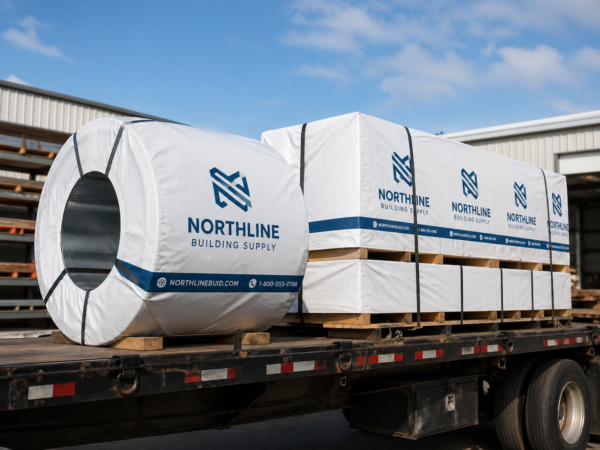
Measure the package that leaves your yard
Measure after the bundle is assembled in its normal shipping configuration. Record dimensions in one unit throughout the worksheet. A mix of feet and inches is an easy way to order the wrong width.
- Length (L): the greatest end-to-end dimension, including uneven board ends.
- Width (W): the widest outside face of the stack.
- Height (H): the highest point of the stack, including stickers or other items inside the planned wrap.
Note whether bearers sit inside or outside the packaging. Record corner protectors, protrusions, and band locations. Measure several representative bundles, including the largest configuration, rather than assuming every stack is identical.
For engineered wood or mixed-length bundles, photograph both ends and the side profile. An irregular load may need a different fold, separate end protection, or a custom size even when its total surface area looks similar.
Choose the coverage pattern before calculating width
A top cover, a three-sided cover, and a full circumferential wrap use different amounts of material. These geometric starting points describe a rectangular bundle; they are not product-specific installation instructions.
- Top only: W, plus any specified side overhangs.
- Top and two full sides: W + 2H, plus the specified attachment or fold allowance.
- All four long faces: 2W + 2H, plus the specified seam overlap.
End closures add another requirement. Decide whether the same sheet folds over the ends or whether you will use separate caps. Ask the packaging supplier to approve the closure detail and moisture-management approach before ordering. A tighter enclosure is not automatically suitable for lumber that still needs to dry.
Confirm the roll orientation
Roll width and roll length are not interchangeable. Draw the bundle and mark which dimension lies across the roll. Two layouts are possible:
- Roll width around the cross-section: the width must accommodate the perimeter and seam. Cut length runs along the bundle, with any required end-fold allowance.
- Roll width along the bundle: the width must accommodate bundle length and end allowances. Cut length runs around the cross-section and includes the seam.
Show that drawing to the supplier. If neither layout fits the available roll, discuss a wider material, separate end caps, or an approved multi-piece pattern. Do not assume that joining two narrow strips produces equivalent protection.
Work through a circumference example
Assume a rectangular bundle measures 16 ft long × 4 ft wide × 3 ft high. For complete coverage of its four long faces:
Cross-section perimeter = 2 × (4 + 3) = 14 ft.
If an illustrative seam allowance is 1 ft, the material dimension around that cross-section becomes 15 ft. The 1 ft allowance is an example only; use the actual closure specification.
A 9 ft-wide roll cannot span this 15 ft requirement in a single piece when the width goes around the stack. Rotating the sheet does not solve it either if the roll width must cover a 16 ft bundle length before end folds. This is why checking square footage alone is insufficient.
R-Value’s custom metal and lumber wrap page lists standard 9 × 100 and 9 × 150 rolls and custom dimensions. Confirm units, usable width, coverage pattern, and the exact size available for your load when requesting a quote.
A complete sizing example: a bundle that fits a 9 ft roll
Here is a worked cut plan for a 12 ft long × 2 ft wide × 2 ft high bundle. It uses a four-face sleeve around the long faces, with separate end caps. The dimensions and allowances below are illustrative geometry, not an approved installation specification or a customer result.
| Item | Calculation | Result |
|---|---|---|
| Cross-section perimeter | 2 × (2 ft + 2 ft) | 8 ft |
| Illustrative seam overlap | 8 ft + 1 ft | 9 ft sheet width |
| Sleeve cut length | 12 ft; ends covered separately | 12 ft per bundle |
| 150 ft usable roll | 150 ÷ 12, rounded down | 12 sleeves; 6 ft leftover |
| 100 ft usable roll | 100 ÷ 12, rounded down | 8 sleeves; 4 ft leftover |
| 100 bundles using 150 ft rolls | 100 ÷ 12, rounded up | 9 rolls before extra cuts |
| 100 bundles + 4 setup cuts + 6 replacement cuts | 110 ÷ 12, rounded up | 10 rolls; end-cap stock separate |
What this proves: a sheet with 9 ft of usable width can geometrically cover this 8 ft perimeter and the assumed 1 ft overlap. It does not prove that the material, seam, or end caps suit the wood condition or exposure. Verify usable dimensions and the closure specification before applying this cut plan to a purchased roll. A nominal width that is even slightly narrower than the required cut leaves no room for the planned overlap.
Why end coverage must be calculated separately
A 2 ft × 2 ft end face has 4 square feet of face area, but that is not a finished end-cap cutting size. Attachment overlaps, folds, corner treatment, and closure tolerances increase the blank size. For 100 bundles, plan for 200 end closures plus separately counted trial and replacement pieces. Obtain an approved cap drawing before converting that count into a material order.
If using integral end folds instead, the sleeve cut becomes L + allowance at end A + allowance at end B. Recalculate yield with that longer cut. Do not use the separate-cap yield while also expecting the sleeve to close both ends.
Copyable lumber-wrap sizing worksheet
Copy this table into your purchasing sheet, complete one version per bundle family, and print it with your wrapping sketch. Enter all dimensions in feet or all in inches; convert once before comparing them with the roll specification.
| Record | Your entry |
|---|---|
| Product, bundle ID, date, and units | ________________ |
| Maximum outside L × W × H | ________________ |
| Bearers, stickers, bands, and protrusions inside coverage | ________________ |
| Coverage: top / three faces / four faces | ________________ |
| Roll orientation and required usable width | ________________ |
| Approved overlap and end-closure drawing | ________________ |
| Cut length including integral folds, if used | ________________ |
| Usable roll length ÷ cut length; round down | ________________ complete cuts per roll |
| Bundle count + setup + replacement cuts | ________________ total cuts |
| Total cuts ÷ cuts per roll; round up | ________________ rolls |
| Separate caps, repair stock, and trial materials | ________________ |
| Trial result, approved pattern, and approver | ________________ |
Three checks that prevent an expensive repeat order
- Fit the largest bundle: if the 2 ft height becomes 2 ft 3 in while width stays 2 ft, the perimeter rises to 8 ft 6 in. The same 1 ft seam now needs 9 ft 6 in of sheet width.
- Count usable leftovers: the 6 ft remainder in the example cannot produce another 12 ft sleeve. Reuse it only for a separately approved smaller cut.
- Check print direction: mark the outward face and logo position on the cut sketch. A dimensionally correct pattern can still leave the logo upside down or hidden under the seam.
Send a complete sizing brief with your quote request
Give the supplier enough information to recommend a practical size:
- Minimum and maximum L × W × H for each bundle type, with units.
- Photos or a sketch showing bearers, stickers, banding, and protrusions.
- Coverage pattern, end-closure method, and proposed roll orientation.
- Lumber condition at packing and expected storage and transport exposure.
- Bundles shipped per week, desired delivery date, and delivery location.
- Logo artwork, print orientation, and which faces should display the branding.
Keep packaging selection separate from load securement. Wrap sizing does not establish that the bundle is restrained correctly for transport. Use the applicable securement procedures and qualified handling personnel.
Before placing a repeat-size order, wrap a representative bundle and inspect seam fit, end coverage, band contact, and material use. Record the approved cut dimensions so different shifts follow the same pattern.
Size and moisture control belong in the same conversation
The USDA Forest Products Laboratory’s Storage of Lumber handbook discusses package wrapping and protection during transit and storage. Use packaging as part of a storage plan, with the wood’s condition and exposure considered alongside fit.
For the next step, send R-Value your bundle measurements and wrapping sketch. Ask for confirmation of roll size, closure details, and expected yield before committing to a production order.
Before finalizing the packing method, read our guide to why wrapped lumber gets wet and the moisture questions to raise with your supplier.
Frequently Asked Questions
Should I use nominal lumber dimensions to size the wrap?
No. Measure the finished bundle’s outside dimensions. Nominal board sizes do not account for actual board dimensions, stack arrangement, stickers, overhangs, or packaging hardware.
Can one roll width fit every bundle?
Only if each bundle and its approved wrapping pattern fit within that width. Check the largest bundle in each product family and any end closures before standardizing.
Should I add a fixed percentage for waste?
Use measured cut lengths and a trial run. Add a separate allowance based on actual rejects and handling loss; do not count the same overlap or trim twice.
Are end caps included in a roll-yield estimate?
Only when their material use is included explicitly. Separate end sheets, caps, or patches must be added to the order calculation.
